Leave Your Message


China has become a major sourcing base for Cam Straps, supported by mature textile, hardware, and export manufacturing networks. Global buyers now expect more than low prices. They need consistent webbing strength, reliable cam buckles, accurate labeling, and traceable quality controls.
The World Bank’s Logistics Performance Index 2023 evaluated 139 economies across customs, infrastructure, shipment quality, and delivery reliability. Its findings reinforce one practical lesson: supply-chain dependability matters as much as production capacity. The European Commission’s cargo-securing guidance also stresses suitable restraint systems, correct tension, and regular inspection. These principles are highly relevant when comparing Chinese Cam Straps manufacturers.
Small details matter.
A strap may look identical in a product photo, yet differ in webbing density, stitching pattern, buckle tolerance, or corrosion resistance. Cargo-securement trainer John R. McLennan summarizes the risk clearly: “A restraint is only trustworthy when its capacity is verified, not assumed.” Buyers should request test reports, breaking-strength data, material specifications, and production samples before placing large orders.
This guide reviews China’s top 10 Cam Straps manufacturers for global buyers. It considers manufacturing experience, customization ability, inspection practices, export support, and product consistency. The ranking is not perfect. Supplier capabilities can change, and published specifications may not reflect every production batch. That is why independent verification remains essential. A strong supplier should welcome factory audits, sample testing, and clear documentation. In practical terms, the right Cam Straps manufacturer helps protect cargo, reduce replacement costs, and make international procurement less uncertain.
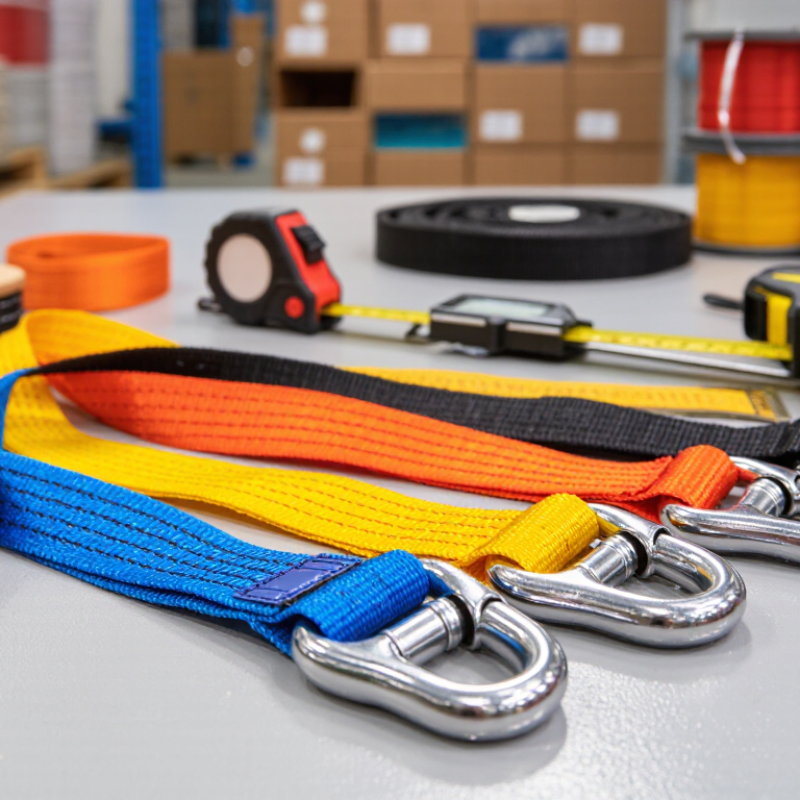
A cam strap is a webbing tie-down with a spring-loaded cam buckle. Press the lever to feed the strap through, then release it to grip the webbing. It tightens by hand, so it is useful for securing kayaks, boxes, and light equipment without a ratchet’s high tension. The buckle should sit flat, and the strap should not twist. Small details matter.
For road cargo, a cam strap is not automatically suitable just because it feels tight. The U.S. Federal Motor Carrier Safety Administration’s cargo-securement rule specifies performance forces of 0.8 g forward and 0.5 g sideways or rearward (49 CFR §393.102). These figures concern the securement system, not a promise that any single strap can handle a load. Check the strap’s working load limit, inspect stitching and hardware, and use enough tie-downs for the cargo. A dented buckle is easy to overlook.
Tips: Place soft padding under webbing where it crosses sharp edges. Pull the free end firmly, then check tension after a short drive. Cam straps can loosen or slip on smooth, vibrating loads; they are not a universal solution. I still recheck them, even when the setup looks tidy.
| Product Type | Typical Construction | Common Uses | Key Selection Factors | Important Safety Note |
|---|---|---|---|---|
| Light-duty cam buckle strap | Woven polyester webbing with a spring-loaded metal cam buckle | Securing light cargo, coolers, and equipment on roof racks or trailers | Webbing width, strap length, buckle material, and stated working load limit | Use only for cargo restraint; it is not designed for overhead lifting or fall protection. |
| General-purpose cam strap | Polyester webbing and a corrosion-resistant steel or alloy buckle | Bundling materials and securing recreational or household loads | Stitching quality, buckle grip, weather resistance, and end fitting options | Check the strap and buckle for cuts, fraying, deformation, or corrosion before use. |
| Heavy-duty cargo cam strap | Wider, high-strength polyester webbing with reinforced sewn ends | Securing heavier cargo when the application and product rating permit | Documented working load limit, webbing strength, buckle capacity, and traceability | Do not exceed the lowest rated component or the applicable cargo-securement requirements. |
| Cam strap with S-hooks | Cam buckle strap fitted with metal hooks at one or both ends | Attaching cargo restraints to suitable anchor points on trailers or racks | Hook shape, hook material, anchor compatibility, and strap rating | Hooks must be fully engaged on appropriate anchors and must not be side-loaded. |
| Cam strap with loop ends | Webbing sewn into soft loops, often to reduce metal-to-surface contact | Securing items where hooks could scratch or damage the load | Loop size, stitch pattern, webbing length, and compatible attachment method | Protect the webbing from sharp edges and verify that each loop is securely seated. |
| Cam strap with flat hooks | Polyester webbing paired with flat metal end fittings | Use with compatible flat-slot or track-style anchor points | Fitting dimensions, finish, anchor fit, and rated capacity | Use only with compatible anchors; a poor fit can allow the fitting to disengage. |
| Short utility cam strap | Short webbing length with a compact cam buckle | Bundling tools, securing small items, and organizing equipment | Useful length, buckle release action, and resistance to abrasion | Keep excess webbing clear of moving parts and avoid using it as a lifting sling. |
| Long-load cam strap | Extended polyester webbing with a cam buckle and selected end fittings | Securing longer items such as boards or recreational equipment | Required length, buckle position, load contact points, and stated rating | Prevent strap contact with sharp edges and recheck tension after the load settles. |
| Weather-resistant cam strap | Polyester webbing and hardware selected for outdoor exposure | Outdoor equipment, marine recreation, and repeated exposure to moisture | Material specifications, coating or finish, UV exposure guidance, and maintenance needs | Rinse off salt or contaminants where appropriate, then inspect and dry before storage. |
| Custom-specification cam strap | Webbing, buckle, length, color, and end fittings configured for a defined application | OEM programs, specialized cargo restraint, and repeat production orders | Approved drawings, test documentation, labeling, sampling, and quality controls | Confirm ratings and test requirements for the finished assembly, not just individual components. |