Choosing the best Polyester Sling supplier in China requires more than comparing prices or browsing polished factory photos. The right supplier must demonstrate consistent web quality, accurate load ratings, controlled stitching, and dependable inspection records. A serious buyer should examine fabric certificates, test reports, production experience, and traceability for every batch. Small details matter. Look closely at seams, labels, edge protection, and packaging.
Lifting-equipment specialist Daniel Reed explains, “A sling is trusted only when its materials, stitching, and working limits are proven together.” This principle shapes our evaluation. A capable Chinese manufacturer should understand working load limits, safety factors, abrasion risks, ultraviolet exposure, and proper sling configuration. The factory should also provide clear instructions for inspection, storage, and retirement. Certifications help, but they never replace practical evidence. An impressive document cannot repair careless workmanship.
There is no perfect supplier. That deserves honest attention. Some factories offer excellent production but weak communication. Others respond quickly but provide incomplete technical records. Buyers may also overlook after-sales support, especially when delivery pressure rises. Our guide compares suppliers through a practical E-E-A-T lens: manufacturing experience, technical expertise, industry authority, and trustworthy evidence. We consider factory audits, sample testing, customer feedback, customization capability, and export performance. The best Polyester Sling supplier is not simply the cheapest option. It is the manufacturer that delivers stable quality, transparent communication, and safe performance under real working conditions. That difference becomes visible when a sling carries a heavy load in a noisy warehouse, beneath sharp steel edges, or under repeated daily use.
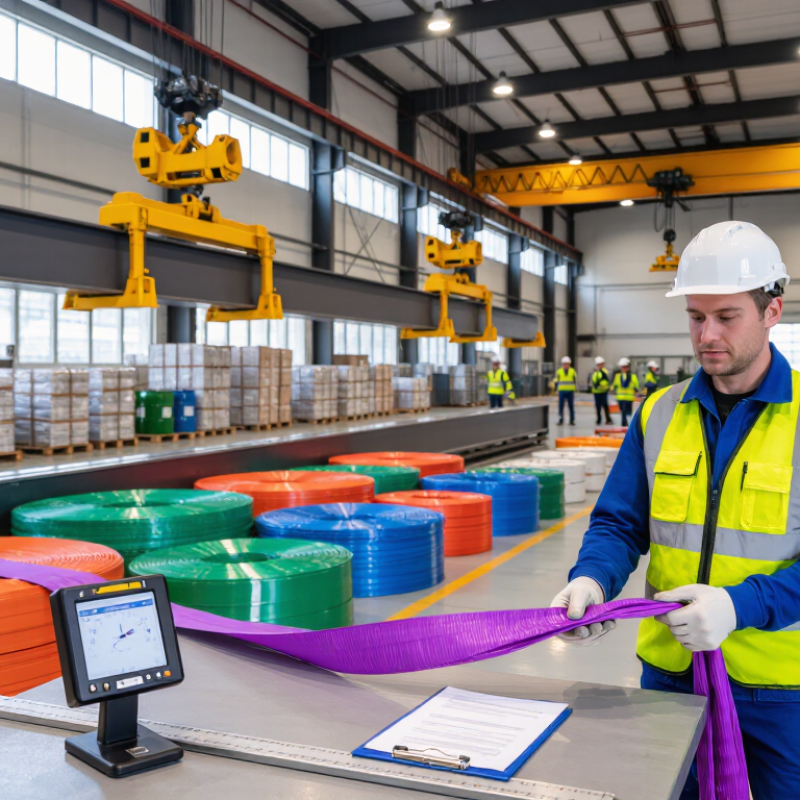
A polyester sling is a flexible lifting strap made from woven polyester fibers. It connects a load to a crane, hoist, or other lifting equipment. Compared with steel wire rope, it is lighter and easier to handle. It also reduces contact marks on painted or polished surfaces. However, it is not indestructible. Sharp edges, excessive heat, chemical exposure, and poor storage can weaken the webbing.
Supplier selection directly affects lifting safety and operating costs. An experienced supplier should confirm the working load limit, sling length, width, eye configuration, and lifting method before production. Guessing is risky. Ask how the supplier controls fiber quality, weaving tension, stitching, and label accuracy. Each sling should have clear identification, rated capacity, inspection guidance, and traceable batch records. Independent or in-house testing can verify strength, elongation, and construction consistency.
A reliable supplier will explain limitations instead of promising everything. Request samples and inspect the stitching closely. Uneven seams, loose threads, damaged edges, or unclear markings deserve attention. The supplier should also provide practical advice for storage, inspection, and retirement criteria. Factory experience matters here. Still, documents alone are not enough; site conditions may differ from laboratory tests. A careful buyer should compare technical evidence with actual handling needs, including load shape, temperature, frequency of use, and possible edge contact. Mistakes sometimes begin with an incomplete specification.
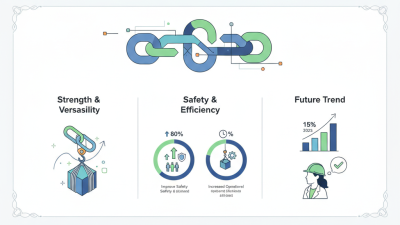
A reliable polyester sling supplier should work against recognized technical standards, not attractive pricing alone. In China, GB/T 8521 helps define safety requirements for textile lifting slings. For international projects, EN 1492-1 and ASME B30.9 are also important references. These standards address working load limits, construction, identification, testing, and safe use. A serious manufacturer should confirm which standard matches your lifting environment and destination market.
Quality becomes visible during production. Inspect the polyester webbing for even stitching, clean edges, and consistent width. Each sling should carry a readable label showing working load limit, length, material, and manufacturer traceability. Test reports should explain tensile strength and proof-load results. They should not merely show a passing stamp. Ask how the factory controls damaged seams, color variation, and incomplete labels.
From practical inspection experience, chemical exposure, sharp corners, and ultraviolet light can reduce sling life quickly. A supplier should provide clear inspection guidance and reject criteria. Color coding alone is not enough. I would also request batch records and sample testing before a large order. No inspection system is perfect. Certificates can become outdated, and paperwork may hide weak process control. The better question is whether the supplier can consistently connect each sling to its material, test result, and production record.
Choosing a Chinese polyester sling supplier requires more than comparing unit prices. During factory audits, I check whether the company controls yarn, weaving, stitching, and final inspection. A reliable supplier should provide batch numbers, material specifications, working load limits, and traceable test records. EN 1492-1 requires textile slings to use a 7:1 safety factor, so vague strength claims deserve caution. Ask for the actual test method, not only a polished certificate.
Physical samples reveal uncomfortable details. Inspect edge binding, stitch density, label durability, and uneven webbing tension. Rub the sling against a steel corner, then examine loose fibers and seam distortion. Polyester can lose performance through abrasion, ultraviolet exposure, chemicals, or excessive heat. The International Labour Organization reports that unsafe work equipment remains a major contributor to occupational injuries, reinforcing the need for documented inspection routines. A supplier should explain rejection criteria clearly.
Factory capability also matters. Review calibration records, internal nonconformity reports, and corrective actions from the last twelve months. Independent laboratory testing is stronger evidence than an ISO 9001 certificate alone. The certificate shows a management system, not automatic product quality. Request samples from different production batches, because one perfect sample proves little. Trade data from the International Trade Centre consistently places China among the leading exporters of textile products, but export volume does not guarantee lifting expertise. I would compare response speed, technical answers, and replacement procedures before signing. Some suppliers dislike these questions. That is useful information.
When evaluating a polyester sling supplier in China, buyers should inspect the manufacturing process, not only the catalog. Ask for fiber specifications, yarn denier, webbing width, and production tolerances. A reliable factory should explain how yarn is woven, dyed, heat-set, stitched, and labeled. Request batch records and sample measurements. The webbing should feel even, with no thin edges, loose threads, oil marks, or sudden color changes. Small flaws matter.
Quality control should cover tensile strength, stitching strength, abrasion resistance, ultraviolet exposure, moisture, and dimensional stability. Check whether each sling receives a proof test or other documented inspection before shipment. The working load limit must match the design, test results, label, and traceability records. Do not accept a certificate without the correct production lot number. Testing should follow recognized lifting-equipment standards relevant to the destination market. Independent laboratory reports add confidence, especially for large or repeated orders.
A factory visit can reveal details that documents hide. Watch operators inspect needle tension, seam spacing, edge quality, and label placement. Ask how rejected slings are isolated and recorded. Check calibration dates on testing machines. A supplier may pass one attractive sample but struggle with consistency across hundreds of pieces. I would not rely on appearance alone. Buyers should compare random samples from different batches, review complaint records, and confirm corrective actions. My own inspection would include cutting open a rejected sample when permitted, because hidden stitching problems are easy to miss.
EN 1492-1 uses standardized colors to identify the working load limit (WLL) of flat woven polyester slings. Buyers should confirm that the sling color, label, stitching, material specification, proof-test records, and traceability documents match the declared WLL before approving a supplier.
Reference: EN 1492-1 color identification for flat woven lifting slings. Orange represents 10 tonnes and above.
Choosing a polyester sling supplier in China requires more than comparing the lowest quotation. I once compared unit prices only and overlooked stitching quality, packaging, and inspection fees. That mistake made the final cost higher than expected. Ask for a detailed quote covering sling length, width, working load limit, labels, cartons, and shipping terms.
Customization should be checked through practical samples. Request photographs of webbing edges, reinforced eyes, stitching density, and protective sleeves. A reliable factory should explain material grades, color fastness, batch tracking, and load testing. Ask whether your logo, barcode, warning label, or packaging design affects the minimum order quantity. Small details matter. An attractive sample proves little without consistent production records.
Export service often separates a capable supplier from a cheap one. Review their experience with commercial invoices, packing lists, certificates, and destination-specific documents. Confirm whether they can arrange inspection before shipment and provide clear production updates. Compare delivery time using the same shipping method and trade terms. A supplier with a slightly higher price may reduce delays and communication problems. Still, promises are not evidence. Check references, request recent test reports, and verify that documents match the actual product. Even experienced buyers can miss a small specification change.
Anonymous comparison of typical China-based polyester webbing sling supplier capabilities
| Comparison Dimension | Supplier Profile A | Supplier Profile B | Supplier Profile C | Supplier Profile D | Supplier Profile E |
|---|---|---|---|---|---|
| Typical Product Focus | Standard polyester webbing slings for general lifting | Heavy-duty round slings and webbing slings | Custom printed and color-coded lifting slings | Small-batch industrial lifting products | High-volume OEM and export production |
| Indicative Price at 1,000 Pieces | US$2.20–4.80 per piece | US$3.80–9.50 per piece | US$2.80–6.20 per piece | US$3.50–8.80 per piece | US$1.90–4.30 per piece |
| Price Basis | 1-ton, 1-meter eye-and-eye sling; standard color | 2–5-ton capacity; reinforced eyes and protective sleeves | Custom color, label, and packaging included in quotation | Mixed specifications with smaller order quantities | Standard specifications under consolidated production orders |
| Minimum Order Quantity | 100 pieces per specification | 200 pieces per specification | 300 pieces per specification | 50 pieces per specification | 500 pieces per specification |
| Sample Policy | Paid samples; fee usually refundable after bulk order | Paid samples; testing samples available | Custom samples require artwork and setup confirmation | Low-volume samples available with standard specifications | Samples available before mass production approval |
| Standard Production Lead Time | 15–25 days after approval | 20–35 days after approval | 25–40 days, depending on customization | 10–20 days for standard items | 18–30 days for repeat orders |
| Material Options | 100% high-tenacity polyester | High-tenacity polyester with abrasion-resistant sleeves | Polyester webbing with custom labels and protective covers | Standard polyester webbing in common widths | Polyester webbing with multiple width and capacity options |
| Common Width Range | 25–300 mm | 50–300 mm | 25–200 mm | 25–150 mm | 25–300 mm |
| Working Load Limit Options | 1–10 tons, depending on configuration | 1–20 tons, depending on sling type | 1–8 tons, with custom identification labels | 1–5 tons for common stock specifications | 1–20 tons, subject to design review |
| Customization Capability | Color, length, width, stitching, label, and packaging | Length, lifting configuration, sleeves, hooks, and fittings | Color matching, logo label, barcode, packaging, and documentation | Length, color, label, and basic packaging | Full OEM specifications, packaging, and production drawings |
| Custom Label or Logo MOQ | 500 pieces or 1,000 labels | 500 pieces | 300 pieces | 100 pieces | 1,000 pieces |
| Quality Control Process | Incoming material inspection and final visual inspection | Material checks, stitching inspection, and load testing by batch | Production inspection and label or packaging verification | Basic dimensional and stitching inspection | Incoming, in-process, final, and batch traceability checks |
| Test Documentation | Factory test report available on request | Batch test report and product identification available | Product specification sheet and selected test records | Standard product inspection record | Batch test report, inspection record, and traceability data |
| Relevant Standards Support | EN 1492-1 or AS 1353.1, subject to product design | EN 1492-1, AS 1353.1, or customer specification | Standard-based labeling and documentation by order | Common market specifications; confirm compliance before purchase | EN 1492-1, AS 1353.1, and customer inspection requirements |
| Export Experience | Regular shipments to distributors and industrial buyers | Experienced in heavy-duty industrial export orders | Suitable for private-label and retail-ready shipments | Suitable for trial orders and smaller importers | Suitable for recurring container and OEM programs |
| Common Trade Terms | FOB, CIF, FCA, and EXW | FOB, CIF, CFR, and DAP by quotation | EXW, FOB, CIF, and DDP for selected destinations | EXW, FOB, and courier delivery for samples | FOB, CIF, CFR, DAP, and consolidated shipment options |
| Export Documentation | Commercial invoice, packing list, bill of lading, and certificate of origin | Commercial invoice, packing list, test documents, and shipping documents | Commercial invoice, packing list, artwork records, and origin documents | Basic commercial and shipping documents | Complete export document package with batch records when required |
| Typical Payment Terms | 30% deposit and 70% before shipment | 30% deposit and 70% before shipment | 30%–50% deposit depending on customization | 30% deposit and balance before shipment | 30% deposit and 70% before shipment; terms negotiable for repeat orders |
| Best Fit For | General importers seeking balanced cost and standard products | Construction, transport, and heavy-lifting applications | Private-label distributors and customized product programs | Startups, test orders, and low-volume buyers | Large distributors and long-term OEM purchasing programs |
| Overall Value Rating | ★★★★☆ | ★★★★☆ | ★★★★☆ | ★★★☆☆ | ★★★★★ |
Comparison note: Prices and lead times are indicative market ranges for polyester webbing sling orders and can change according to capacity, length, width, hardware, testing requirements, packaging, order volume, and destination. Buyers should request a current quotation, product drawing, test report, and compliance documentation before placing an order.