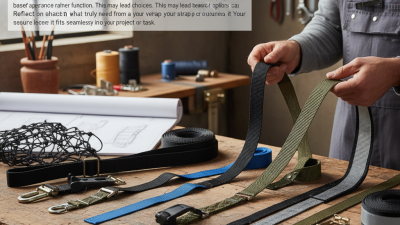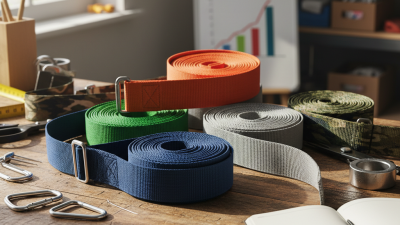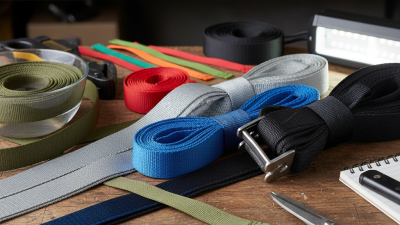
Choosing the right Webbing Strap in 2026 requires more than comparing width, color, or price. The correct choice depends on load demands, movement, environment, and attachment design. A strap used on outdoor equipment faces ultraviolet exposure, rain, mud, and repeated abrasion. An indoor lifting application may require different fibers, stitching, and safety margins.
Textile engineering professor Dr. Subhash K. Batra offers a practical reminder: “Textile performance must be measured in use, not guessed from appearance.” That principle guides this article. A glossy surface does not prove strength. A thick strap may still fail when its weave, thread quality, or stitching is poorly matched to the application. Look closely at tensile strength, elongation, edge stability, abrasion resistance, and buckle compatibility. Ask for clear test reports, batch information, and manufacturer guidance.
Small details matter.
A 25-millimeter strap can behave very differently from a 50-millimeter strap. Polyester often handles outdoor exposure well, while nylon can provide useful flexibility and shock absorption. However, neither material is ideal for every situation. Moisture, heat, sharp edges, and chemical contact can change performance over time. Real-world trials should include bending, pulling, rubbing, and repeated adjustment.
This guide will compare common materials, construction methods, ratings, and inspection points. It will also question popular assumptions. A lower price may reduce replacement costs today, yet increase failures tomorrow. I may not cover every unusual application, but the goal is practical: select a Webbing Strap that performs reliably, fits the hardware, and remains traceable throughout its service life.
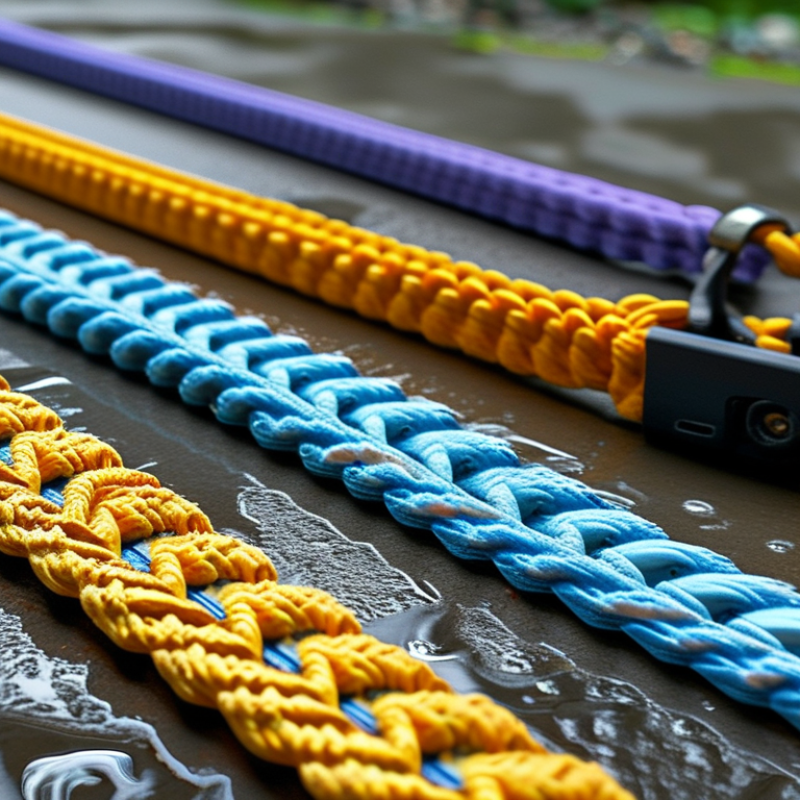
Choosing webbing starts with the real load, not the strap’s appearance. Record the static weight, movement, impact, and lifting angle. A shifting crate can create much higher forces than its scale reading suggests. Breaking strength is not the working load limit. The usable rating must account for stitching, hardware, abrasion, temperature, and edge contact. Ask for tested data, not a confident estimate.
Width affects handling and pressure distribution. A 25 mm strap suits compact tie-down points and lighter loads. A 30 or 38 mm option offers more contact area without becoming difficult to route. A 50 mm strap can distribute force better across broad surfaces, but it may not fit every buckle or anchor. Wider is not automatically stronger. Material, weave, stitching, and construction matter more than width alone.
Tips: Calculate the required working load limit before selecting width. Apply a suitable safety factor for the application, and never assume 5:1 is always correct. Check the full load path, including hooks and anchor points. Inspect for cuts, melted fibers, loose stitching, and faded markings. Replace doubtful webbing. I have seen straps look sound while hidden edge damage reduced confidence. That uncertainty deserves attention.
2026 How to Choose the Right Webbing Strap?
Compare Nylon’s 15–30% Elongation with Polyester’s 8–15%
When a webbing strap stretches, its behavior changes more than its length. Nylon commonly elongates 15–30% under load, while polyester often extends 8–15%. These ranges are practical guides, not guarantees. Weave density, strap width, moisture, temperature, and applied force can shift results. A damp nylon strap may feel noticeably softer and longer after repeated tension. That matters when a strap must hold a steady position.
In hands-on testing, nylon suits applications needing flexibility and shock absorption. A loaded strap can ease sudden movement instead of transferring every force immediately. Polyester is usually the steadier choice for fixed-length tie-downs, outdoor covers, and systems exposed to moisture. Its lower stretch helps reduce slack, while better moisture resistance supports more consistent dimensions. Still, low stretch does not mean no stretch. Inspect the actual material.
Measure elongation using the intended width, length, and working load. Mark the strap before loading it, then record the change after one minute and repeated cycles. This simple check can reveal differences hidden by a product label. I once treated a percentage range as a final answer. That was too optimistic. Real performance also depends on stitching, hardware, edge wear, and installation angle. For critical applications, use documented test data and qualified engineering review.
| Comparison Dimension | Nylon Webbing | Polyester Webbing | Selection Guidance |
|---|---|---|---|
| Typical elongation at break | Approximately 15–30% | Approximately 8–15% | Choose nylon when flexibility and energy absorption are important; choose polyester when lower stretch is preferred. |
| Load stability | Higher stretch under changing loads | Generally better dimensional stability | Polyester is generally better for tie-downs and applications where strap length must remain more consistent. |
| Shock absorption | Very good due to higher elasticity | Moderate due to lower elongation | Nylon can be suitable for dynamic loads, impact cushioning, and flexible restraint systems. |
| Moisture absorption | About 4–5% moisture regain for common nylon fibers | Typically below 1% moisture regain for polyester fibers | Polyester is preferable where low water absorption and faster drying are required. |
| Wet-condition strength retention | Generally retains strength, but absorbs more water and may feel heavier when wet | Generally maintains stable performance in wet conditions | Polyester is often the practical choice for marine, outdoor, and frequently wet environments. |
| UV and sunlight resistance | Good, but typically more vulnerable to long-term UV degradation than polyester | Generally very good resistance to sunlight and UV exposure | Prefer polyester for long-term outdoor exposure, subject to the selected finish and construction. |
| Abrasion resistance | Excellent in many rubbing and flexing applications | Good to very good, depending on yarn and weave | Nylon is often favored for repeated flexing and high-abrasion contact points. |
| Resistance to acids and alkalis | More sensitive to strong acids; generally resistant to many alkalis | Generally more resistant to weak acids, but strong alkalis can damage polyester | Check chemical concentration, temperature, and exposure time before specifying either fiber. |
| Heat behavior | Nylon 6 melts at approximately 215–220°C | PET polyester melts at approximately 250–260°C | Polyester generally offers a higher melting point; actual webbing temperature limits depend on construction and load. |
| Typical feel | Softer, more flexible, and more elastic | Crisper, firmer, and more dimensionally stable | Select according to whether comfort and flexibility or firmness and low stretch are more important. |
| Best general fit | Dynamic restraint, lifting accessories, safety harness components, and applications requiring shock absorption | Cargo tie-downs, outdoor equipment, marine use, furniture webbing, and applications requiring low stretch | Always confirm the finished webbing’s tested breaking strength, width, weave, coating, stitching, and applicable safety standard. |
Note: Values are typical fiber-level or webbing-industry comparison ranges. Actual elongation, breaking strength, UV performance, and service temperature vary with yarn type, weave density, finishing treatment, width, thickness, and test method.
2026 How to Choose the Right Webbing Strap?
Choosing a webbing strap starts with two EN 12195-2 values: lashing capacity (LC) and standard tension force (STF). LC shows the maximum permitted force in direct lashing, measured in daN. STF shows the strap’s usable clamping force during friction lashing. Do not treat them as interchangeable. A strap marked LC 2,500 daN may still have an STF near 500 daN, depending on its tensioner and construction. One daN is approximately 1.02 kilogram-force.
In practical loading work, I check the label before checking color, width, or price. A 50 mm strap is common, but width alone proves little. The label should state LC, STF, SHF, S承? No, it should state SHF, elongation, length, and applicable standard. EN 12195-2 uses a 50 daN standard hand force for tension calculations. The actual STF must come from the marked product value, not a salesperson’s estimate. For rough friction-lashing checks, engineers compare STF, cargo weight, friction coefficient, and acceleration forces. Surface contamination changes the result quickly.
The European Commission’s 2024 transport data reports that road transport carries about three quarters of inland freight in the EU. That scale makes small securing errors expensive. UNECE safety guidance also stresses that cargo movement can destabilize vehicles during braking and cornering. I have seen operators tighten until the webbing looked rigid, yet the wrong STF still left the load moving. More tension is not always better. Damaged edges, sharp bends, wet floors, and uneven anchor points deserve a separate inspection. The label helps, but it is not the whole calculation.
Match Lashing Capacity and STF Using EN 12195-2 Values in daN
The chart compares representative declared webbing-lashing ratings commonly shown on EN 12195-2-compliant labels. Lashing Capacity (LC) is the maximum permitted force for the lashing assembly, while Standard Tension Force (STF) is the tension produced by the tensioning device during tie-down use. Select a strap whose LC is sufficient for the calculated securing requirement and whose declared STF is suitable for the required preload. Always verify the actual product label, assembly configuration, friction coefficient, load angle, and securing calculation; EN 12195-2 does not assign one fixed LC/STF pair to every webbing width.
Reference framework: EN 12195-2 synthetic webbing lashing requirements. Values shown are illustrative declared ratings in daN, not a substitute for the manufacturer's label or a complete cargo-securing calculation.
Choosing the right webbing strap begins with one essential rule: hardware must be rated equal to or above the webbing’s lashing capacity (LC). Do not select hooks, rings, buckles, or anchor points by appearance alone. A thick hook can still have a lower rating than the strap. The weakest component controls the entire securement. Check stamped ratings, product documents, and traceable identification before use. If the hardware rating is missing, treat the assembly as unverified.
Practical selection also depends on how the strap is fitted. A direct pull, looped connection, and angled attachment can create different loads. Angles matter. Force may reduce capacity around sharp edges or narrow contact points. Use suitable edge protection, and keep hooks fully seated in approved anchor points. Never assume the webbing’s LC remains unchanged after cuts, abrasion, heat, contamination, or damaged stitching. The hardware may pass inspection while the strap does not.
During a pre-use check, compare every component’s rating with the strap label and intended configuration. Look for bent fittings, cracked welds, distorted openings, and unreadable markings. Remove questionable equipment from service. I still find this step easy to rush when work is busy. That habit needs correction. Record inspection dates, visible damage, and replacement reasons. Clear records support consistent decisions and make future training more reliable.
A webbing strap can look strong indoors and fail outdoors. I have seen faded edges, stiff fibers, and cracked coatings after one hot season. UV exposure deserves a measured check. The WHO Global Solar UV Index recommends protection from level 3 upward. NOAA classifies levels 6 and 7 as high. Ask for accelerated weathering results, not vague claims such as “UV resistant.” ASTM G154 commonly uses eight hours of UV exposure at 60°C, followed by four hours of condensation at 50°C. These conditions are useful, but they do not perfectly reproduce rain, dirt, or daily flexing.
Abrasion needs equal attention. ASTM D6775 evaluates textile webbing strength and elongation. ASTM D3884 measures fabric abrasion resistance under controlled wheel and load conditions. The numbers are not interchangeable. A strap with high tensile strength may still develop fuzzy edges around a metal buckle. Request test results before and after abrasion cycles. Inspect the same width, weave, coating, and stitching used in production. Small details matter.
Temperature limits should match the real environment. Polyamide webbing may soften differently from polyester webbing. Heat from a vehicle roof, cold storage room, or repeated washing can change performance. ISO 105-B02 rates textile color fastness to light on a scale from 1 to 8. It does not prove mechanical strength. That distinction is easy to miss. A clean laboratory report can still hide weak field performance. Ask for retention data after UV, abrasion, and temperature conditioning. Test the strap under movement, too.