Leave Your Message


Fabric Sling selection is not a style decision alone. For global buyers, the right construction depends on load shape, handling frequency, abrasion, moisture, and inspection routines. A flat webbing sling can sit neatly beneath a broad pallet; a round sling can cradle a curved component with fewer sharp contact points. Small details matter: a rough edge, trapped grit, or unreadable label can change a sound purchase into a poor one.
The International Labour Organization’s 2023 estimates report nearly three million work-related deaths and 395 million non-fatal work injuries worldwide each year. Those figures cover many industries, not sling-related incidents specifically, but they underline why lifting accessories deserve careful selection. Buyers should compare material, rated capacity, edge protection, traceability, and inspection guidance—not price alone. EN 1492-1 and EN 1492-2 provide useful reference points for textile flat woven and round slings; confirm which requirements apply to the intended market and use.
A verified expert quotation was not included in the supplied source material, so attributing one here would risk misleading readers. That gap matters. This guide instead focuses on evidence buyers can check: product markings, manufacturer documentation, and suitability for the actual lift. Even a well-made sling can be misused, and specifications do not replace competent inspection. The aim is practical clarity, not false certainty: compare the main Fabric Sling types, understand their trade-offs, and ask suppliers for details before a load leaves the floor.
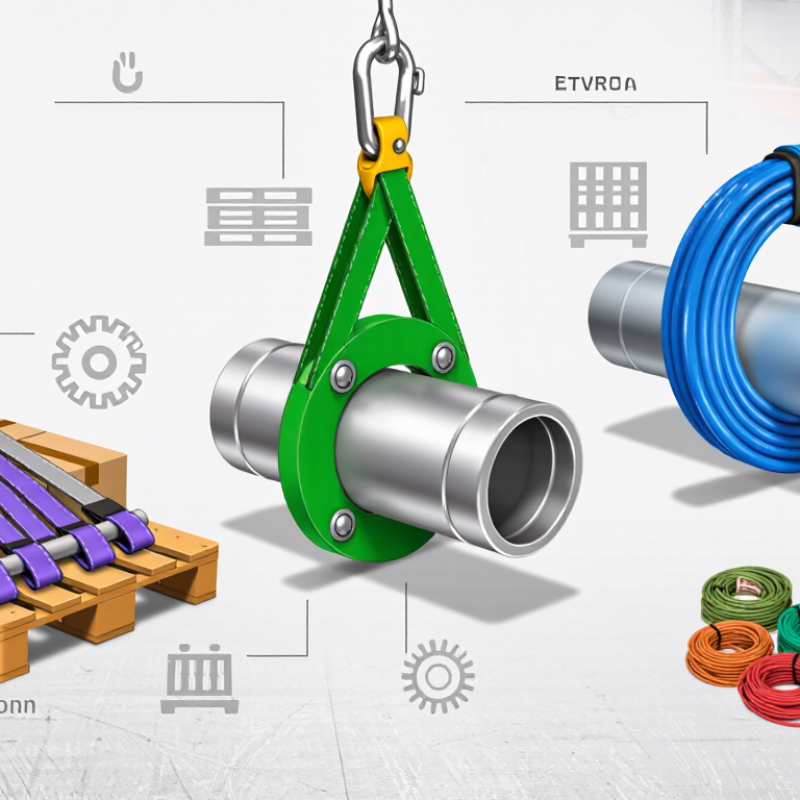
A fabric sling’s WLL, or Working Load Limit, is the maximum load it is rated to lift under specified conditions. It is not the same as breaking strength. Under EN 1492’s 7:1 design factor, the sling’s minimum breaking force is designed to be at least seven times its WLL. A sling marked for a 1,000 kg WLL therefore has a much higher specified breaking force, but that margin is not spare capacity for routine lifting. Never use it to justify lifting beyond the label.
Configuration matters. A basket hitch, a choke hitch, or a changed sling angle can alter the permitted load. Check the tag for WLL, sling type, and applicable configuration, then compare it with the lift plan. Small details matter. A sharp steel edge can cut webbing; grit trapped in a fold can wear it during a lift. Inspect seams, stitching, and labels before use, and remove damaged or unreadable slings from service. Real lifts rarely look as neat as diagrams. I would still pause if the load, angle, or sling condition seems uncertain; a simple rating cannot answer every site-specific question.
| Sling type | Typical construction | Example straight-lift WLL | Minimum breaking force at 7:1* | Typical applications and buyer checks |
|---|---|---|---|---|
| Flat webbing sling — eye and eye | Woven synthetic webbing with a load-bearing eye at each end; commonly supplied in single- or multi-ply construction. | Common nominal examples include 1 t, 2 t, 3 t, 5 t and 8 t. | 1 t: 68.6 kN 2 t: 137.3 kN 5 t: 343.2 kN 8 t: 549.2 kN |
Useful for general-purpose lifting. Check eye dimensions, width, edge protection and compatibility with the hook or attachment point. |
| Flat webbing sling — endless | Webbing joined into a continuous loop; can be repositioned around a load to distribute wear. | Common nominal examples include 1 t, 2 t, 3 t, 5 t and 10 t. | 1 t: 68.6 kN 2 t: 137.3 kN 5 t: 343.2 kN 10 t: 686.5 kN |
Often selected for choker or basket arrangements. Inspect the full circumference and protect the webbing from sharp edges. |
| Round sling — endless | Load-bearing synthetic yarns enclosed in a protective tubular sleeve; the sleeve is not, by itself, the load-bearing core. | Common nominal examples include 1 t, 2 t, 5 t, 8 t and 10 t. | 1 t: 68.6 kN 2 t: 137.3 kN 5 t: 343.2 kN 10 t: 686.5 kN |
Flexible and suitable for many irregular loads. Do not use if the sleeve is damaged enough to expose or compromise the core; follow the maker’s inspection criteria. |
| Two-leg web sling assembly | Two web sling legs connected to a top link, with end fittings or eyes selected for the load and lifting points. | Assembly WLL is specified for the leg configuration and permitted angle; it is not simply twice the WLL of one leg. | Determine from the assembly’s marked WLL and applicable standard; do not estimate from the number of legs alone. | Check the angle between legs, load balance, centre of gravity and whether all legs are expected to share the load. |
| Multi-leg round sling assembly | Two-, three- or four-leg assembly using round sling legs, top links and compatible fittings. | WLL depends on the number of legs, leg angle, assembly design and applicable rating information. | Use the marked assembly rating and manufacturer documentation; a single-leg rating is not the assembly WLL. | Useful where several lifting points are available. Confirm that the load and rigging arrangement keep the legs within their rated conditions. |
Standards and rating notes
EN 1492-1 covers flat woven webbing slings, and EN 1492-2 covers roundslings. The 7:1 design factor means a minimum breaking force seven times the working load limit (WLL), expressed on a consistent force basis. The force figures above are calculated examples using 1 tonne-force = 9.80665 kN; they are not product test results.
WLL is specific to the sling and its rated lifting arrangement. Choke or basket hitches, sling angles, edge conditions, temperature, chemical exposure and other service factors can affect permitted capacity. Always follow the sling’s identification label, applicable standard and manufacturer instructions.