Leave Your Message


Global buyers are examining Webbing Sling manufacturers more carefully than ever. Demand is rising across construction, logistics, shipyards, wind energy, and factory maintenance. Grand View Research reported that the global industrial lifting equipment market reached approximately USD 77 billion in 2023. Its forecast also indicates continued growth through 2030. However, this figure covers more than slings. It should not be treated as a dedicated Webbing Sling market value.
This guide compares ten manufacturers serving international buyers. It considers material traceability, stitching quality, working load limits, testing systems, customization, and export experience. EN 1492-1, ASME B30.9, and ISO-based quality procedures provide useful reference points. OSHA 1910.184 also highlights inspection, identification, and safe sling use in workplaces. These standards matter beside a clean warehouse floor, visible labels, and an intact protective sleeve.
Safety scholar James Reason wrote, “We cannot change the human condition, but we can change the conditions under which humans work.” His observation applies directly to lifting equipment. A strong supplier supports safer decisions through clear markings, inspection guidance, and practical documentation. Yet no manufacturer is perfect. Some publish impressive certificates but provide limited field support. Others offer low prices while leaving buyers to interpret technical details alone. That gap deserves attention. The best choice depends on load geometry, environment, frequency of use, and local compliance needs. A bright polyester sling may look reliable, but hidden abrasion, heat damage, or poor storage can change the risk completely. This review aims to make that evaluation clearer, more realistic, and easier to verify.
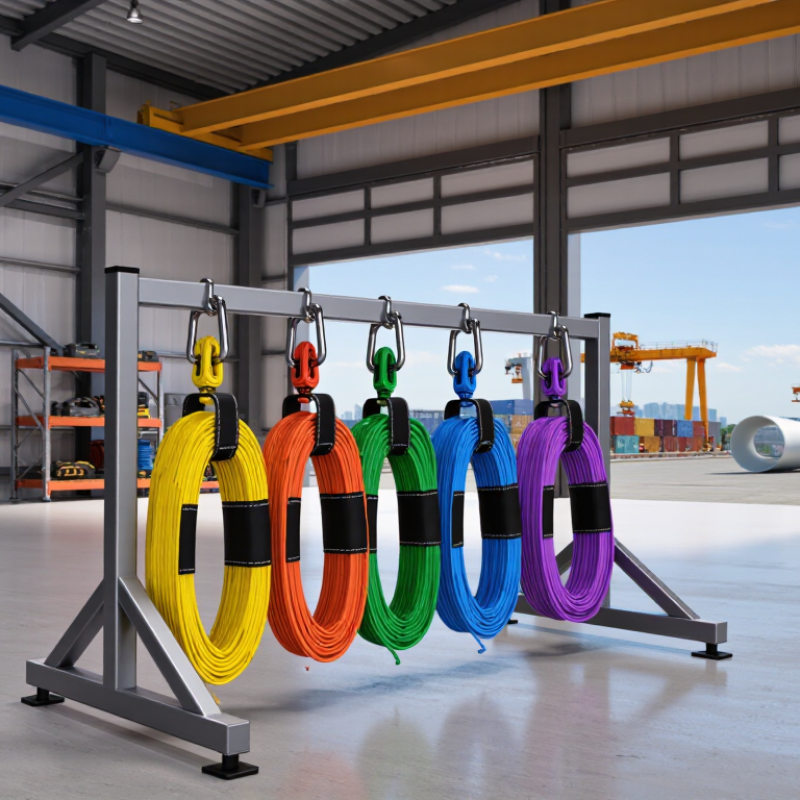
Global buyers evaluate webbing sling manufacturers through evidence, not catalog claims. A practical audit checks lifting capacity, stitch quality, fiber consistency, and test records. EN 1492-1 and ASME B30.9 provide recognized requirements for synthetic slings, including identification, rated capacity, and inspection controls.
Traceability is critical. Each sling should carry a durable label showing material, length, working load limit, and manufacturing reference. Buyers should request batch-level test reports, not a single sample certificate. The ISO Survey 2023 recorded more than 1.26 million ISO 9001 certificates worldwide. Certification helps, but it does not replace product-level verification. That distinction is often missed.
Safety procedures also reveal manufacturing maturity. OSHA 29 CFR 1910.184 requires synthetic web slings to receive inspection before use, with removal from service when damage affects strength. Reliable manufacturers explain rejection criteria with photographs and training records. They also control edge protection, heat exposure, abrasion, and chemical contact during production. Look closely at stitching. Uneven seams are not a small cosmetic issue.
Export readiness matters too. Can the supplier provide consistent dimensions across repeat orders? Are packaging, customs documents, and spare labels handled accurately? A technically capable factory may still fail through weak communication. Buyers should compare test data, audit findings, response time, and corrective-action records. No evaluation is perfect. Human inspection still carries uncertainty.
| No. | Evaluation Dimension | Recommended Benchmark for Top-Tier Manufacturers | Why It Matters to Global Buyers | Suggested Weight | Verification Evidence | Target Rating |
|---|---|---|---|---|---|---|
| 1 | Compliance with Lifting Standards | Products designed and tested in accordance with EN 1492-1 for flat woven webbing slings and, where applicable, ASME B30.9 requirements. | Recognized technical standards help buyers compare safe working loads, product design, marking, and inspection requirements across markets. | 18% | Current declarations of conformity, test reports, technical files, product labels, and published standard references. | Excellent |
| 2 | Material Quality and Construction | High-tenacity synthetic webbing, normally polyester or polyamide, with consistent weave density, reinforced eyes, and controlled stitching. | Fiber type, webbing construction, and stitching quality influence strength, elongation, abrasion resistance, and service life. | 15% | Fiber specifications, webbing test records, stitch samples, raw-material inspection reports, and production quality procedures. | Excellent |
| 3 | Safe Working Load Range | A clearly defined range of configurations, widths, lengths, and lifting modes, with rated capacities shown for vertical, basket, and choker applications where applicable. | Clear capacity information reduces the risk of selecting an unsuitable sling for a particular lifting arrangement. | 13% | Load charts, product drawings, permanent labels, configuration tables, and independent proof-load or tensile-test records. | Excellent |
| 4 | Traceability and Product Marking | Every sling includes durable identification showing manufacturer reference, rated capacity, length, material, applicable standard, and manufacturing or batch information. | Traceability supports inspections, recalls, maintenance records, and regulatory audits throughout the product lifecycle. | 12% | Sample labels, batch-control procedures, serial-number systems, material certificates, and documented recall processes. | Excellent |
| 5 | Testing and Inspection Controls | Documented incoming-material checks, in-process inspections, final visual inspection, dimensional checks, and load testing based on product type and applicable requirements. | Consistent inspection controls help prevent defects such as damaged stitching, incorrect labels, uneven webbing, and inadequate capacity. | 11% | Inspection plans, calibrated-equipment records, test certificates, nonconformance reports, and corrective-action documentation. | Excellent |
| 6 | Quality Management System | A documented quality-management system, preferably certified to ISO 9001 by an accredited certification body. | A structured management system improves consistency in purchasing, manufacturing, inspection, documentation, and customer complaint handling. | 10% | Valid ISO 9001 certificate, certification scope, audit records, process manuals, and supplier-control procedures. | Very Good |
| 7 | Customization and Engineering Support | Ability to supply different lengths, widths, eye configurations, protective sleeves, color coding, labels, packaging formats, and technical drawings. | Customization helps buyers match sling selection to lifting geometry, local regulations, equipment interfaces, and project requirements. | 8% | Engineering drawings, sample-development records, customization lead times, approved sample procedures, and technical support contacts. | Very Good |
| 8 | Export Capability and Documentation | Experience preparing commercial invoices, packing lists, certificates of origin, product certificates, export packaging, and destination-specific documentation. | Accurate export documentation reduces customs delays and supports smooth delivery to distributors, contractors, and industrial projects. | 6% | Sample export documents, packaging specifications, shipping procedures, customs-support records, and documented delivery performance. | Very Good |
| 9 | Delivery Reliability and Capacity | Stable production capacity, defined standard lead times, documented order planning, and contingency arrangements for raw-material or logistics disruptions. | Reliable supply is important for construction, port, manufacturing, energy, and maintenance projects with fixed schedules. | 4% | Capacity statements, production schedules, historical on-time-delivery data, inventory policies, and continuity plans. | Very Good |
| 10 | After-Sales Guidance and Inspection Support | Clear instructions covering use, storage, cleaning, inspection, rejection criteria, periodic examination, and retirement of damaged slings. | Correct use and regular inspection are essential because webbing slings can be weakened by cuts, abrasion, heat, chemicals, UV exposure, or overloading. | 3% | User manuals, inspection checklists, training materials, technical responses, warranty terms, and documented customer-support procedures. | Very Good |
| Buyer evaluation note: The benchmarks above are intended for a transparent comparison of anonymous manufacturers. Final approval should be based on current certificates, product-specific test evidence, applicable local regulations, and an independent assessment of the intended lifting application. | ||||||